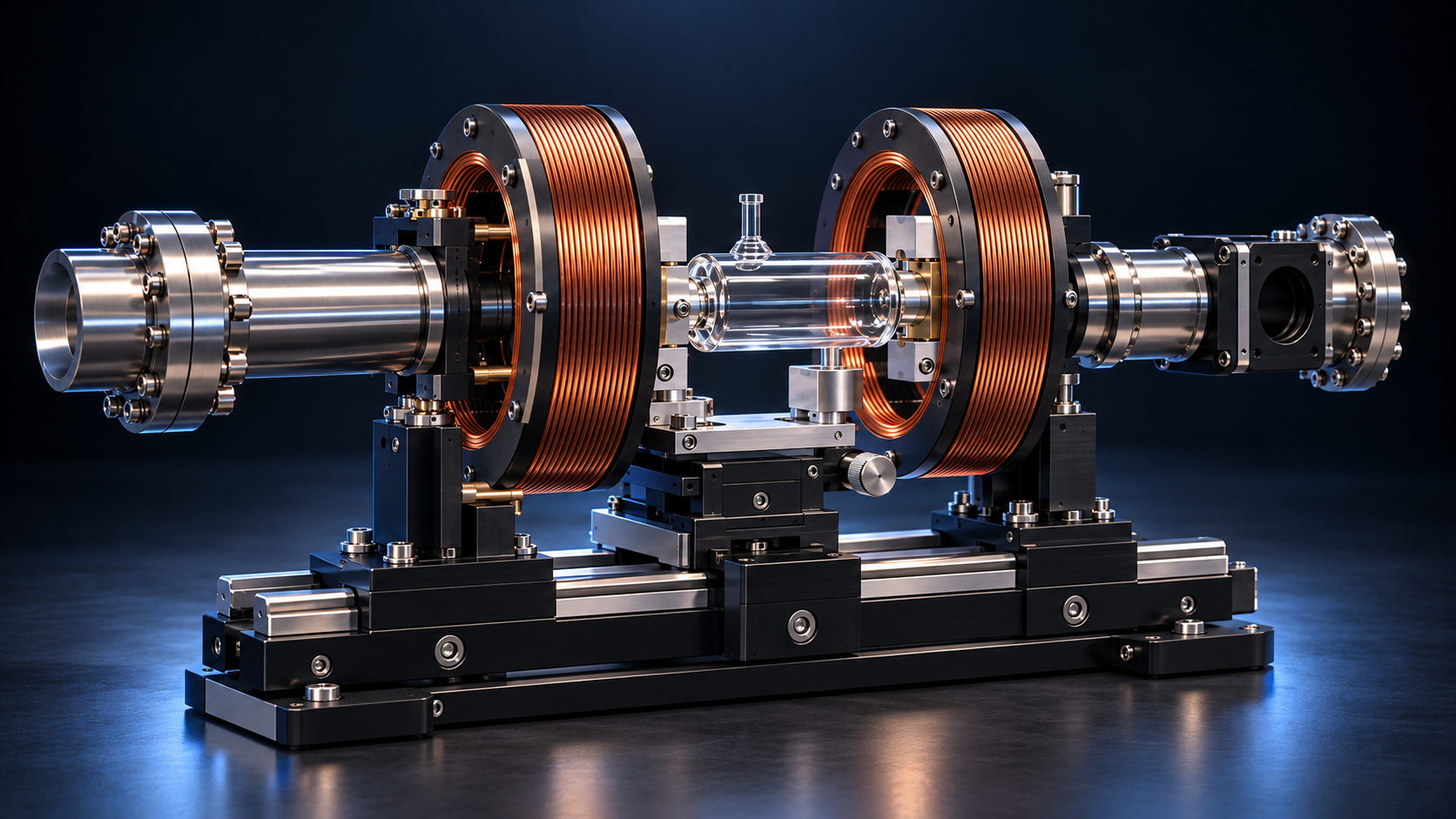
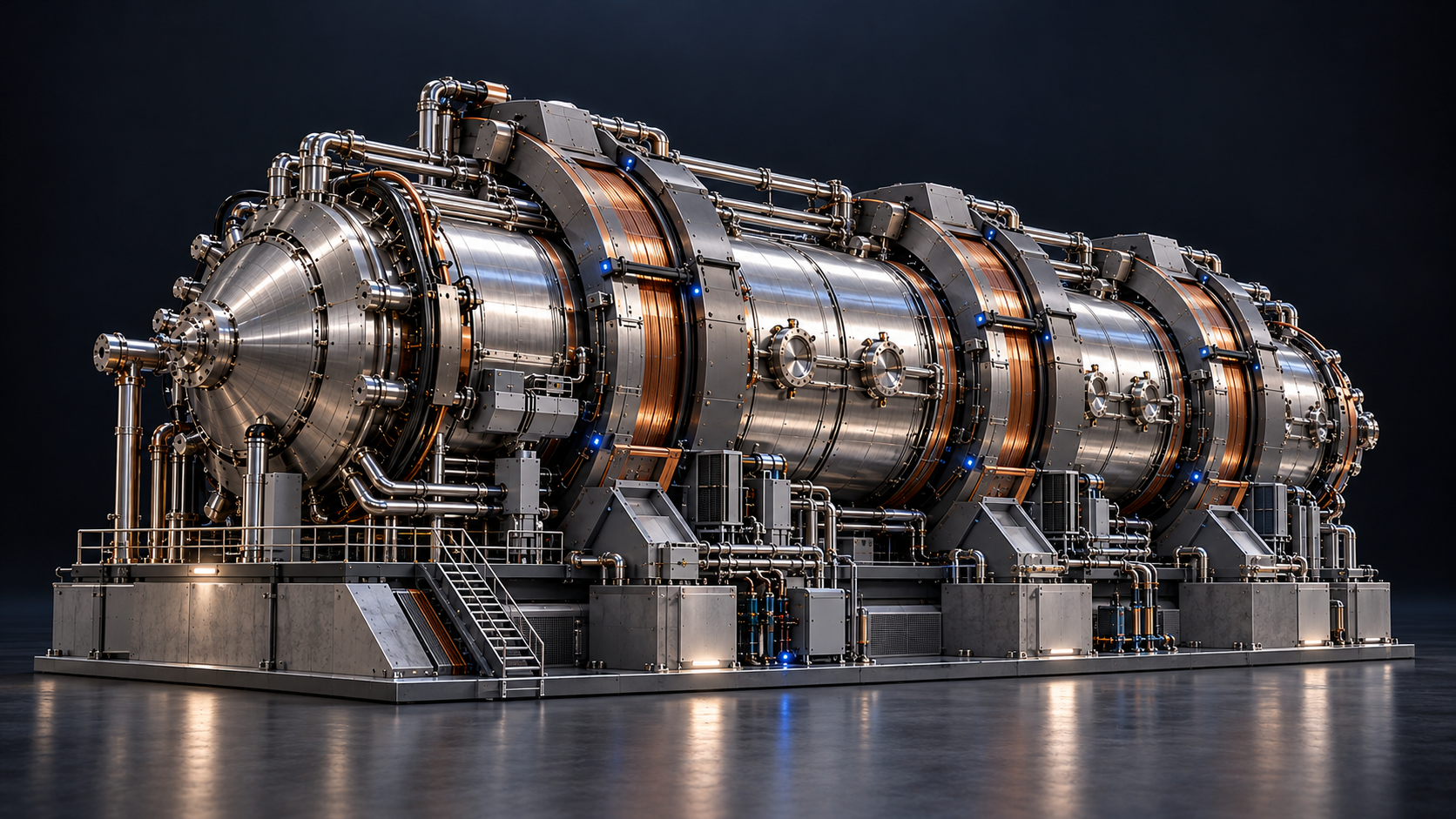
Helium-3 exists on the Moon. Our ambition is to create a path to it.
LUNEL is developing a project to use lunar resources, with helium-3 as its strategic focus. This rare isotope already serves science and advanced technologies, and it may have a future role in fusion energy. We want to create a path to an additional source of this resource, helping its availability support new discoveries and progress on Earth.
This vision is already backed by a developed system concept and substantial project documentation. The knowledge, proposed solutions and development plan provide a starting point for technical discussions, research and preparation of a ground-based demonstrator. We are now seeking the funding and support needed to test selected parts of the project in practice.
CURRENT PROJECT STATUSSystem concept and project documentation developed
THE FOUNDATION WE HAVE BUILT
The concept is developed. Research comes next.
The work to date has produced a coherent concept, design descriptions, visual documentation and a development plan. This body of work preserves the knowledge gained and records key decisions. It gives future contributors a shared foundation for deciding what to investigate, how to assess the results and which resources are needed. It is a substantial asset for LUNEL, created through its founder’s work, knowledge and personal investment.
The concept takes a comprehensive approach to collecting, processing and managing regolith - the loose material covering the Moon’s surface - and recovering its resources. It considers the needs of future operations, available resources and the constraints of the lunar environment. Calculations and research will help assess how to turn these requirements into a working system and which solutions to develop first.
A GLIMPSE OF THE LUNEL VISION
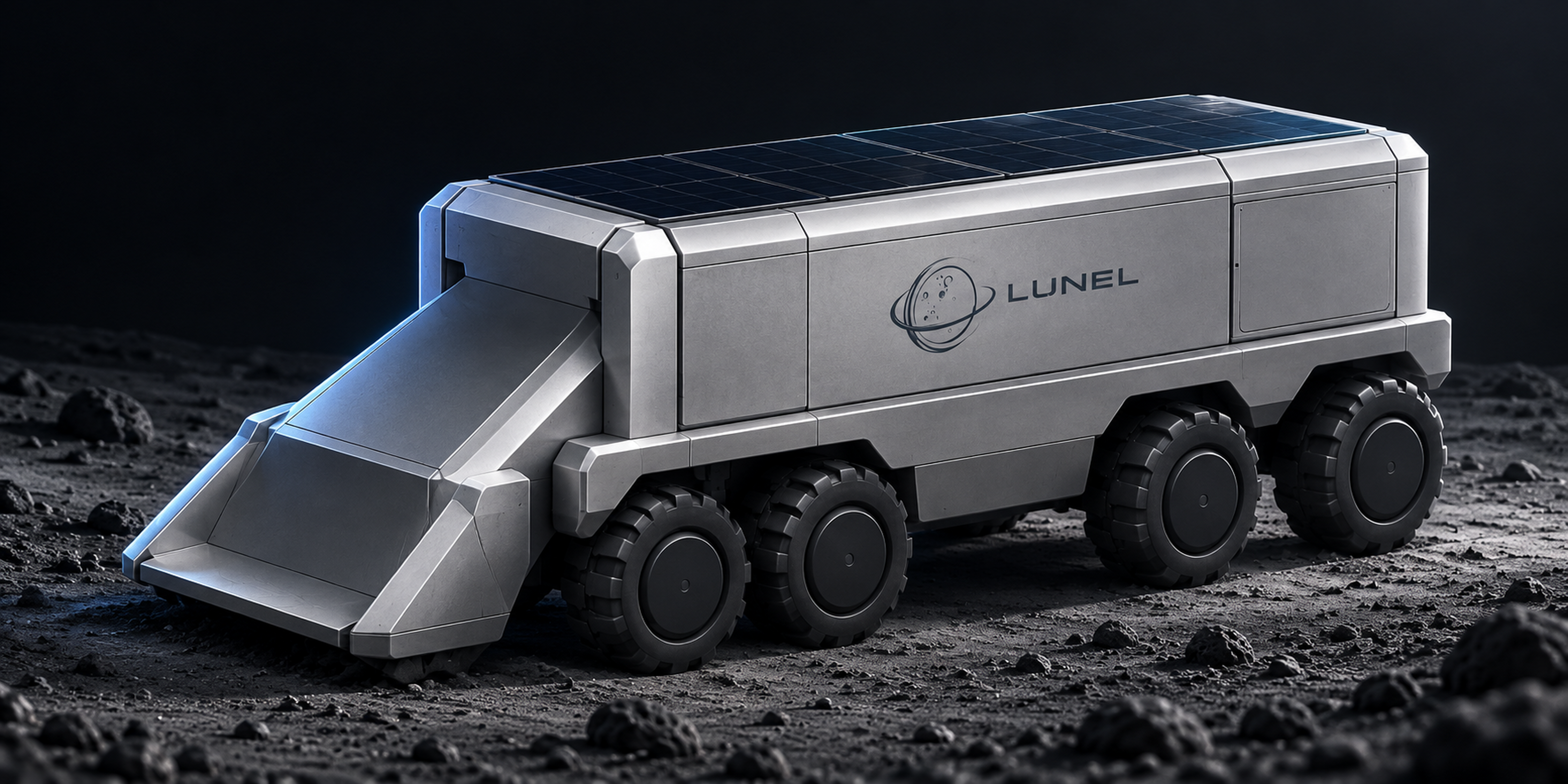
RCM. A vision for collecting regolith.
RCM (Regolith Collection Module) is designed to collect regolith - the loose material covering the Moon’s surface.
ISO01 / 05
Select a view
Simplified concept illustration of RCM, not the current technical configuration or a photograph of a built prototype.
02 / A NAME WITH A STORY+
Lunar. Helium. LUNEL.
LUNEL brings together Lunar, referring to the Moon, and Helium. The name connects the place we are looking towards with the resource at the heart of the project. It also has a personal meaning: Piotr Dytkowski, the creator of LUNEL, grew up in Hel, Poland, where he lived until the age of twenty.
A personal inspiration has grown into a project shaped by sustained work, personal investment and an expanding body of knowledge. That story remains part of LUNEL at every stage.
03 / UNDERSTANDING HELIUM-3+
Compare the isotopes
Tap a particle or its name to explore.
Nuclear spin1/2
Schematic illustration. Particle sizes and positions are illustrative; no fixed electron paths are shown.
A small difference. Remarkable possibilities.
Two protons. One neutron. A stable isotope of helium.
Helium-3 is one of the forms of helium known as isotopes. Every helium atom has two protons in its nucleus; the isotopes differ in their number of neutrons. Helium-3 has one neutron, while helium-4 has two. The number in the name is the total number of protons and neutrons. This small difference changes the atom’s mass and properties, opening up different uses.
These links lead to external scientific background, not LUNEL test results or partner endorsements.
Spin. A small property with a big impact.
Spin is the intrinsic angular momentum of a particle or atomic nucleus, a property described by quantum physics. It does not mean that a particle turns like a small ball. Its effects can be measured: in helium-3, they are linked to how the nucleus responds to a magnetic field.
The helium-3 nucleus has spin 1/2; helium-4 has spin 0. These numbers describe a quantum property, not a number of turns. For helium-3, measuring the spin component along a chosen axis gives one of two outcomes, conventionally called “up” and “down”. Helium-4 has zero total nuclear spin.
A useful analogy is a collection of tiny magnetic needles. Helium-3 nuclei have a magnetic moment, and the gas can be prepared so that one spin orientation is more common. This is polarisation. Such gas can, for example, filter neutrons according to spin. The analogy helps explain nuclear behaviour, but is not a literal picture of nuclear structure.
EXPLORE POLARISATION · HELIUM-3
↑↑↑↑↑↑↑↑↑↑↑↑↑↑↑↑↑↑↑↑↑↑↑↑
↑Chosen axis
Arrows represent the two possible spin projections along one chosen axis. They do not show spinning particles. The proportions are illustrative.
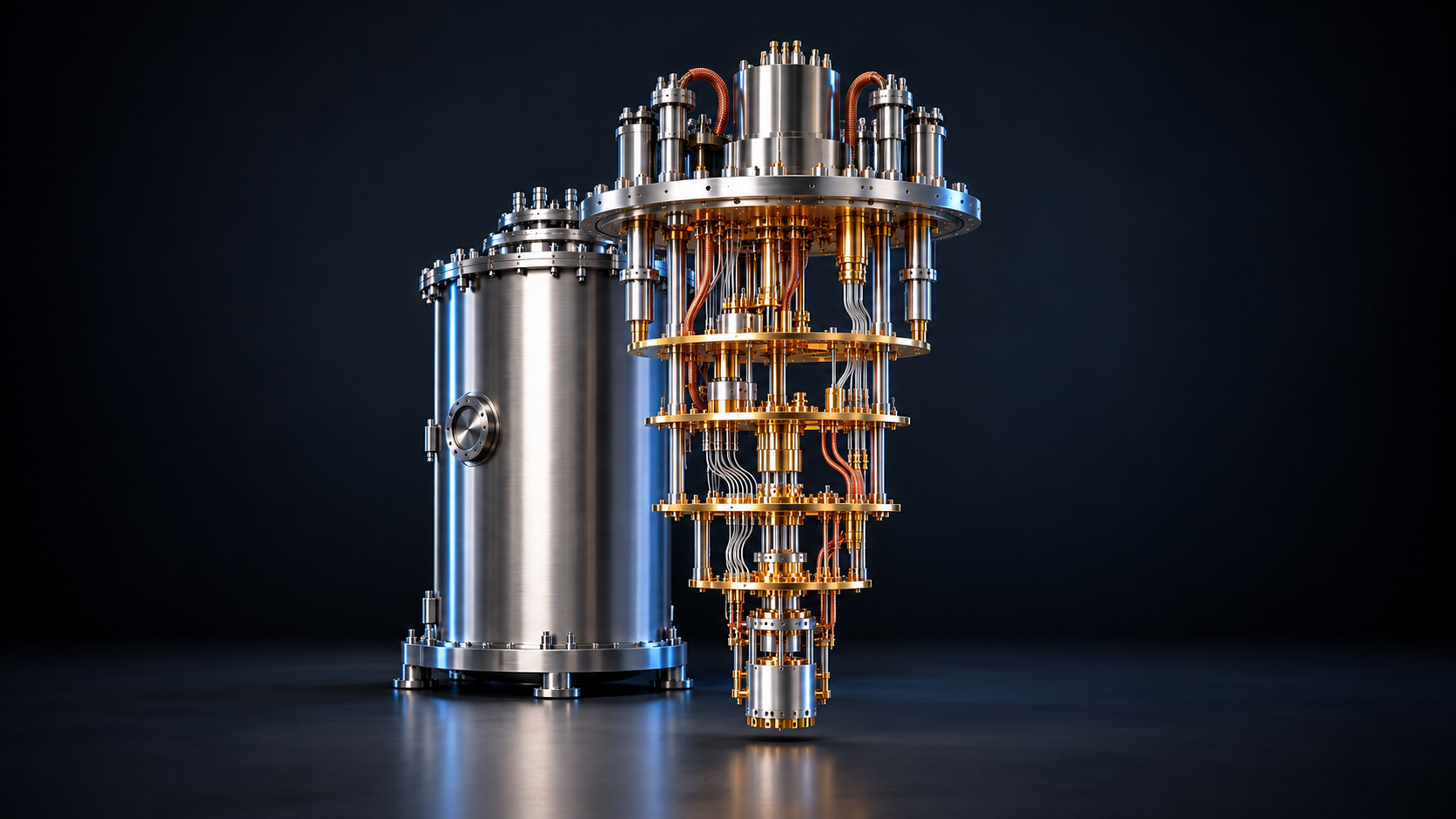
Illustrative images created with AI. They show application areas, not LUNEL equipment.
Enlarge image⤢AN ESTABLISHED APPLICATIONA dilution refrigerator. The outer enclosure is removed here to show the cooling stages.
COOLING AND QUANTUM SCIENCE
Closer to absolute zero.
Specialist refrigerators use a mixture of helium-3 and helium-4 to remove heat from the system being studied. In a dilution refrigerator, helium-3 enters a helium-4-rich phase and absorbs heat. This enables temperatures measured in millikelvins: thousandths of a kelvin above absolute zero. These conditions support superconducting quantum systems and materials research. The helium circulates in a closed loop, so it can be used repeatedly.
Enlarge image⤢AN ESTABLISHED APPLICATIONA helium-3 gas cell in an illustrative neutron spin-filter instrument.
PRECISION MEASUREMENT
See more.
Helium-3 helps detect neutrons, particles found in atomic nuclei. It readily absorbs slow neutrons, a property used in detectors. Its magnetic properties also allow the gas to be polarised, with aligned spin orientations. This makes it a useful research tool in neutron filters and selected medical imaging techniques.
Enlarge image⤢A FUTURE DEVELOPMENT PATHAn imagined future fusion facility, not an existing commercial helium-3 power plant.
A LONGER HORIZON
A possible fuel for future fusion.
Fusion brings light atomic nuclei together. Helium-3 can react with deuterium, a form of hydrogen, releasing energy and producing helium-4 and a proton. It is one of the possibilities being explored for future energy generation. Using it in a power plant requires further development of reactors and fuel supplies. LUNEL focuses on access to the resource needed to explore that possibility.
Naturally occurring helium-3 is very rare on Earth. Some available helium-3 is recovered from the decay of tritium, a radioactive form of hydrogen. Supply therefore depends on a limited range of sources. Earlier shortages prompted recycling and the search for substitutes. For laboratories and emerging technologies, the price, availability and reliability of gas supplies matter: they can affect how quickly its applications develop.
Existing suppliers continue to play an important role. The US Department of Energy (DOE) reports that recycling and alternative technologies have helped secure key federal needs for decades ahead. LUNEL’s ambition is to create an additional source that could support future development at a greater scale.
Resources beyond Earth. Possibilities for life on Earth.
The solar wind is a stream of particles flowing from the Sun. Over billions of years it has also carried helium to the Moon, where some became trapped in the regolith. Helium-3 is held within this loose dust and broken rock. Recovering it requires handling the surface material, releasing the gases it contains, then separating and preparing the desired product.
Reliable, economically viable access to lunar helium-3 could increase its availability and support quantum science, measurement and research into future fusion. This is where we see an opportunity for humanity’s next giant step: the resources of another world helping expand the possibilities of our own.
Helium-3 is dispersed through regolith at very low concentrations. A potential resource becomes a source of supply only when it can be recovered effectively, separated and delivered to a customer. This requires measuring the available resource and assessing the resources consumed and costs across that whole journey. LUNEL connects the vision with the work needed to test its feasibility.
The system concept and substantial project documentation already exist. We are now using that foundation to seek funding, expertise and research facilities. You can contribute as a researcher, company, sponsor, investor or someone interested in LUNEL’s progress. Below, we explain what each form of involvement could make possible.
WHAT YOUR SUPPORT CAN ENABLE
Support will help turn the developed concept into evidence: preparing analysis and a test plan, securing specialist work and access to equipment, then building a rig for an agreed research scope. For each stage, we aim to define the task, budget, schedule and how the results will be assessed, so that each contribution can be connected to the progress it enables.
Choose a form of collaboration to explore how you can get involved.
FOR RESEARCHERS & LABORATORIES
Turn the questions into a research plan.
We invite researchers, universities and laboratories to prepare and carry out studies with LUNEL. We value independent assessment of the assumptions and findings that can guide the next design decisions.
Test planning, equipment selection and research time estimates
Access to laboratory facilities and specialist measurements
Analysis of results against agreed assessment criteria
FOR COMPANIES & SPECIALISTS
Bring experience to the next step.
Companies and specialists can contribute practical skills and facilities needed to prepare research and test equipment. Collaboration can cover a single task or a longer stage, through services or contributions in kind.
Component manufacturing and material selection
Access to equipment, tools or software
Specialist time, technical advice and engineering services
FOR BRANDS THAT LOOK FURTHER
Support a step. Become part of the story.
A sponsor can enable a specific study, preparation of a test rig or a broader programme of work. We also welcome discussions about sponsorship that could add funding to a future community campaign.
Financial support, equipment or services
Agreed brand recognition and communication about progress
Educational activities related to the project
FOR INVESTORS WITH A LONG-TERM VIEW
Capital for research. A longer-term perspective.
We invite investors to discuss funding for research and a ground-based demonstrator. The discussion should focus on the evidence needed to reduce technical uncertainty and assess the case for further stages of development.
Initial research scope and capital requirements
Work programme, milestones and progress assessment
Documentation review and individually agreed investment terms
FOR PEOPLE WHO WANT TO BE PART OF LUNEL
Shared curiosity. A meaningful contribution.
We are considering crowdfunding around a clearly described task, budget and approach to progress updates. The campaign remains to be prepared; its goal, terms and ways to take part will be published when ready. You can already help LUNEL’s community grow through:
Introductions to people, companies and organisations interested in the project
Creative skills and help preparing communications
Sharing information about LUNEL and reaching new audiences
The first step is a discussion about what you can contribute and how it fits the project’s needs. Before work begins, we agree on the scope, responsibilities and expected outcome, along with information access and how results may be used. In parallel, we are preparing grant-funding opportunities matched to the programme of work.
07 / FAQ+
FAQ
No matching answers. Try a shorter phrase or clear the search.
The project. The foundation already built.
What has been developed, and what role does the documentation play?+
LUNEL has a developed system concept and substantial documentation: project descriptions, visual materials and a development plan. They preserve the knowledge gained and key design decisions, giving future collaborators a shared starting point for research, resource planning and funding discussions. Detailed materials are made available through individually agreed arrangements.
Who is behind LUNEL?+
The concept was created by Piotr Dytkowski and is being developed under LUNEL SPACE LTD. He has contributed sustained work, knowledge and personal expenditure to the concept and documentation. The next stage requires specialist expertise, research facilities and funding for research and a ground-based demonstrator.
Where does the name LUNEL come from?+
LUNEL brings together Lunar and Helium: the Moon and the resource at the heart of the project. It also has a personal connection. Piotr Dytkowski grew up in Hel, Poland, where he lived until the age of twenty. The name connects the project’s purpose with its founder’s story.
What is the long-term vision?+
We want lunar resources to expand the possibilities of science, technology and future energy on Earth. Helium-3 is our strategic focus. Our ambition is a comprehensive approach to collecting, processing and managing regolith and recovering its resources, developed step by step through research and measured results.
A rare resource. A wider perspective.
What is helium-3?+
Helium-3, written ³He, is a stable isotope of helium. Its nucleus contains two protons and one neutron. A neutral atom also has two electrons. It is the same chemical element as helium-4, with a different number of neutrons.
Helium-3 has one neutron; helium-4 has two. This changes the mass and quantum behaviour of the atom. The difference is useful in low-temperature science: dilution refrigerators use the properties of both isotopes together to achieve exceptionally low temperatures.
Yes. It is used in ultra-low-temperature cooling for research and selected quantum technologies, as well as neutron detection and specialist measurement. These uses give helium-3 scientific and technological importance alongside its longer-term potential as a fusion fuel.
Helium-3 is naturally very rare on Earth. Available supplies include recovery from tritium decay. Past shortages have encouraged recycling and alternative technologies. Supply, cost and reliability can constrain applications; LUNEL aims to develop an additional source that could support future growth.
Over billions of years, the solar wind has delivered helium to the lunar surface. Some helium-3 is retained in regolith, the loose material covering the Moon. LUNEL sees this as a potential additional resource. Making it useful requires effective recovery, separation and delivery.
Helium-3 is considered a possible fuel for future fusion. Developing a fuel supply and developing a suitable reactor are separate challenges. LUNEL’s role is to pursue access to the resource, while its existing scientific applications remain important.
The conceptual design and substantial documentation are already in place. We are preparing the move into calculations, research and a ground-based demonstrator. Securing the team, facilities and funding will enable that work. Measured performance will be established through the research programme.
What is a demonstrator?+
A demonstrator is a test rig or prototype used to check how a selected part of the project works. It lets the team measure performance, compare results with the intended outcome and identify improvements. Its scope is chosen to answer specific questions before a larger stage of development.
What should the first research establish?+
The aim is to obtain reliable evidence about selected functions: how effectively they work, how much energy they require and how repeatable the results are. Each study should have an agreed method, measurements and acceptance criteria. Those findings will guide the demonstrator and the next design decisions.
Why is development staged, and can research change the design?+
Each stage should answer defined questions and provide a basis for the next investment, linking work, budget and expected results. Measurements may confirm a solution, reveal limitations or indicate a need for changes. The existing documentation provides the reference for assessing and recording those changes.
When can the next stage begin?+
The schedule depends on the agreed research scope, access to specialists and facilities, and secured funding. Preparing those elements is the current priority. A delivery schedule will be linked to confirmed resources and measurable milestones.
An existing foundation. Support for what comes next.
What support is LUNEL seeking, and what would it enable?+
We are seeking funding, specialist expertise and research facilities for analysis, studies, materials, demonstrator preparation and measurements. Support would help turn the existing design work into research evidence. Each stage should have an agreed purpose, scope, budget, responsibilities and criteria for completion.
How could a company sponsor LUNEL?+
A sponsorship could fund an agreed activity or provide equipment, materials or services. Its scope, reporting and any brand recognition would be agreed individually. The starting point is a conversation about the sponsor’s interests and the needs of the next stage.
Can support take a form other than funding?+
Yes. Laboratory time, equipment, materials, specialist services and expertise can all help enable the next stage. A useful contribution is one that meets a defined project need. We can discuss its scope, availability and how it would fit into the planned work.
Are you considering crowdfunding or community support?+
Yes. Community support is one of the routes being considered for clearly defined activities. A campaign would need a specific purpose, budget, delivery plan and participation terms. Details of any launched initiative will be announced when those elements are ready.
Can investors discuss the project with LUNEL?+
Yes. We welcome discussions about the project, its existing body of work and the resources needed for the next stage. The scope of information shared and any potential cooperation would be agreed individually. Please introduce your organisation, interests and the type of involvement you would like to discuss.
Start a conversation. Agree the next step.
What does the RCM image show, and can collaborators see more?+
RCM (Regolith Collection Module) is intended to collect lunar regolith. The public rendering is a simplified illustration, not the current technical configuration or a photograph of a built prototype. Detailed drawings, sections and parameters remain non-public to protect the project’s know-how. Prospective collaborators can discuss access for an agreed purpose, with the recipients and confidentiality arrangements defined beforehand.
The images in the helium-3 applications section are separate educational illustrations created with AI. They do not show LUNEL equipment. The fusion image presents a future concept.
Can universities, laboratories and specialists from other industries get involved?+
Yes. We welcome research, engineering, manufacturing and business experience that meets a project need. Universities and laboratories can help define questions, plan measurements and carry out studies. An initial discussion should cover expertise, facilities, proposed scope, timing and costs; responsibilities would then be agreed for the work.
How can the media request information or brand materials?+
Please contact LUNEL with the topic, intended publication and the materials you need. We can agree the scope of information and suitable brand materials for that purpose. Public communication should accurately distinguish completed project work, the next research stage and long-term ambitions.
How do I contact LUNEL, and what should I include?+
Write to lunelspacecompany@gmail.com or use the introduction tool in the collaboration section. Briefly describe who you are, the organisation you represent, what interests you and the contribution or conversation you propose. This will help us identify a useful next step.
The science behind the vision+
Background reading on helium-3. These sources describe the science; they are not test results or endorsements of LUNEL.